
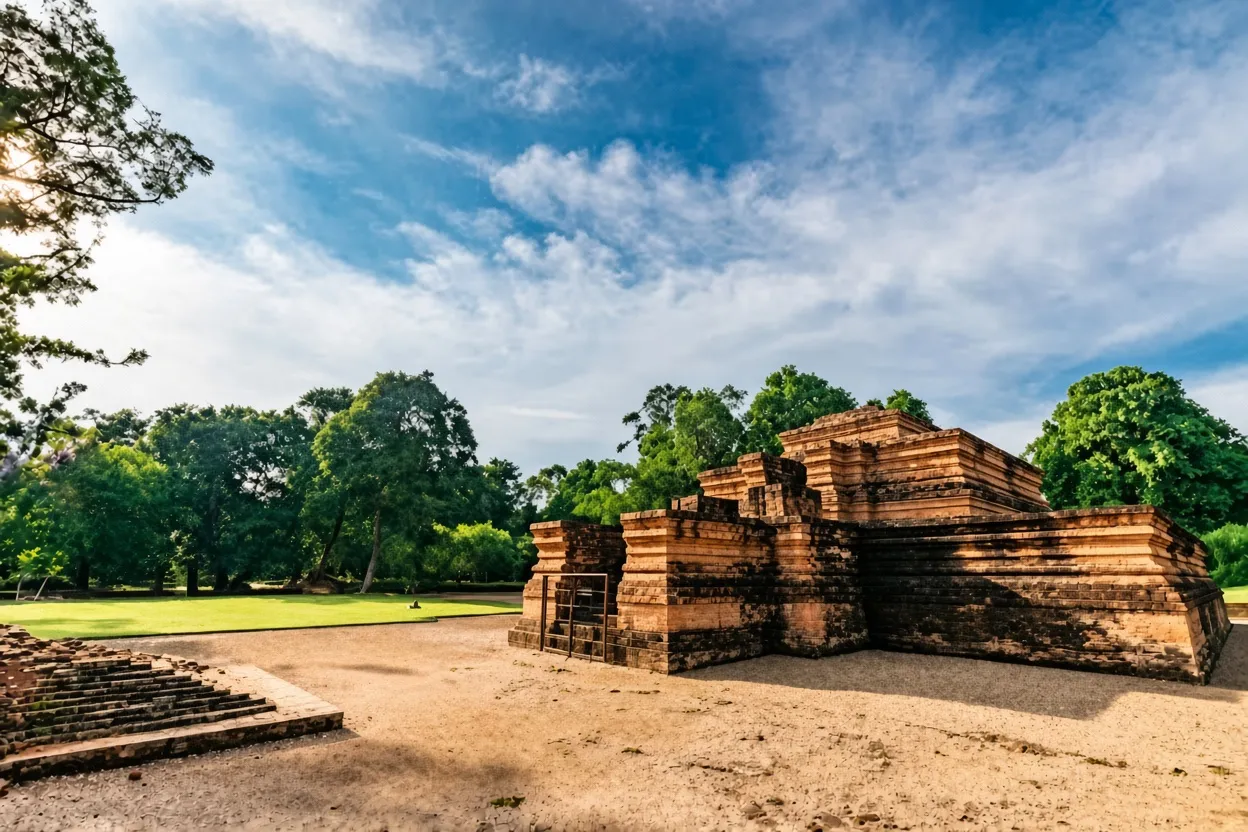
the Muaro Jambi Temple Complex, an ancient site that preserves stories of religion, education, trade, and cultural exchange across Southeast Asia.
Jambi is more than the Batanghari River, traditional Malay culture, and its growing culinary scene. In the lush landscape of Muaro Jambi Regency lies one of Indonesia's most fascinating archaeological treasures, the Muaro Jambi Temple Complex, an ancient site that preserves stories of religion, education, trade, and cultural exchange across Southeast Asia.
For travelers exploring Jambi, a visit to Muaro Jambi offers a different kind of experience. Instead of simply ticking off another tourist attraction, visitors can walk among ancient brick structures, peaceful green landscapes, and archaeological remains that tell the story of a civilization that once connected Sumatra with the wider Asian world.
Getting to Know the Muaro Jambi Temple Complex
The Muaro Jambi Temple Complex is an extensive archaeological site located in Muaro Jambi Regency, Jambi Province, on the island of Sumatra. Covering approximately 3,981 hectares, the complex stretches across several villages and two districts, making it one of the largest Hindu-Buddhist temple complexes in Southeast Asia.The site is closely associated with the historical development of the Malay Kingdom and the Srivijaya period. Archaeological evidence suggests that Muaro Jambi developed as an important religious and educational center from around the 7th to the 14th century.
What makes the site particularly fascinating is that Muaro Jambi was not simply a place of worship. Archaeological findings and historical interpretations indicate that the area may have functioned as a major Buddhist learning center, where subjects such as philosophy, medicine, language, and architecture were also studied.
More Than Just Ancient Temples
When people hear the name Muaro Jambi, they may imagine a single ancient temple standing in the middle of a green landscape. In reality, the complex is much more extensive and consists of numerous archaeological structures spread across a vast area.By 2019, around 101 archaeological sites had been identified within the Muaro Jambi area. These include temple structures, menapo or archaeological mounds, ancient settlements, canals, ponds, and other remains. Some of the significant sites include Candi Gumpung, Candi Tinggi, Candi Kembar Batu, Candi Astano, Candi Kotomahligai, Candi Kedaton, Candi Gedong I, Candi Gedong II, and the Telagorajo Pond.
Because of its enormous scale, exploring Muaro Jambi is best done without rushing. The journey itself becomes part of the experience, especially for travelers interested in history, architecture, photography, and destinations with a peaceful atmosphere.
Tracing an Ancient Buddhist Learning Center
One of the most intriguing aspects of Muaro Jambi is its connection to education. Historical and archaeological evidence suggests that the area was part of a wider Buddhist learning network that connected Sumatra with other parts of Asia, including India, China, and Tibet.The travel accounts of the Chinese Buddhist monk I-Tsing, who visited the region in the 7th century, are among the historical references that help illustrate the importance of Buddhist learning centers in Sumatra. The relationship between the Srivijaya world and Nalanda in India further demonstrates how Sumatra was connected to an extensive intellectual and cultural network.
This makes Muaro Jambi much more than an archaeological destination. The surviving structures offer a glimpse into a period when knowledge, religion, culture, and commerce traveled across borders and connected different civilizations throughout Asia.
The Distinctive Beauty of Ancient Brick Architecture
One of the first things visitors notice at Muaro Jambi is its distinctive architectural material. Many of the temple structures were built primarily from red brick, giving the complex a character that differs from several other famous temple sites across Indonesia.The ancient structures were not necessarily designed as isolated temples. Archaeologists have also identified walls, compounds, waterways, ponds, and other elements that indicate a carefully planned settlement. UNESCO notes that the spatial arrangement provides important insights into how sacred, public, private, and secular spaces were organized within the ancient complex.
For travelers, this means that visiting Muaro Jambi is not simply about looking at an old building. It is an opportunity to imagine how people lived, studied, worshipped, and interacted within this remarkable ancient landscape.
Why Is Muaro Jambi on UNESCO's Tentative List?
The historical importance of Muaro Jambi has attracted international attention. Muarajambi Temple Compound is currently included on UNESCO's Tentative List of World Heritage Sites, with the latest submission recorded on April 15, 2025.UNESCO highlights the site's importance in understanding the development of Hindu-Buddhist religious and educational centers in Asia, as well as the cultural exchanges that took place across the region during the historical period.
It is important to note that being on the Tentative List is different from being officially designated a UNESCO World Heritage Site. The listing represents an important step in the recognition and potential future nomination of the Muaro Jambi Temple Complex.
How to Enjoy a Visit to Muaro Jambi
To make the most of the experience, travelers should allow enough time to explore the area rather than visiting only one temple. Because the archaeological landscape is extensive, different parts of the complex offer their own atmosphere, views, and historical stories.Morning or late afternoon can be particularly enjoyable times to explore, when the atmosphere is generally more comfortable for walking and discovering the site. The combination of ancient brick structures, mature trees, open landscapes, and traditional surroundings also makes Muaro Jambi an appealing destination for photography enthusiasts.
The experience can be made even more meaningful by taking time to observe the communities and cultural landscape surrounding the archaeological site. This allows visitors to see Muaro Jambi not only as a relic of the past, but also as a heritage destination that remains connected to contemporary Jambi.
Complete Your Jambi Journey with BW Luxury Jambi
For travelers making Muaro Jambi part of their Jambi itinerary, choosing comfortable accommodation can make the overall journey more enjoyable. BW Luxury Jambi offers a convenient place to rest and recharge while exploring the city and its surrounding destinations.After spending the day discovering ancient temples and walking through the archaeological landscape, returning to a comfortable hotel provides the perfect opportunity to relax before continuing your Jambi adventure. Travelers can also combine a visit to Muaro Jambi with other experiences, from exploring the city and discovering local cuisine to experiencing the culture and everyday life of Jambi.
Muaro Jambi: An Ancient Story That Still Matters
There is a reason Muaro Jambi continues to attract travelers, historians, archaeologists, and culture enthusiasts. Beyond its ancient brick structures, the site represents a chapter in history when Sumatra played an important role in the movement of knowledge, religion, trade, and culture across Asia.So, when planning your next trip to Jambi, do not limit your itinerary to modern attractions and Instagram-worthy destinations. Set aside time to explore the Muaro Jambi Temple Complex, walk among its ancient remains, enjoy its tranquil surroundings, and imagine how this landscape once served as an important center of learning and spiritual life.
Muaro Jambi is not simply a place to see the past. It is a reminder that Jambi was once part of a much larger story of civilization, connecting Sumatra with the wider Asian world.